
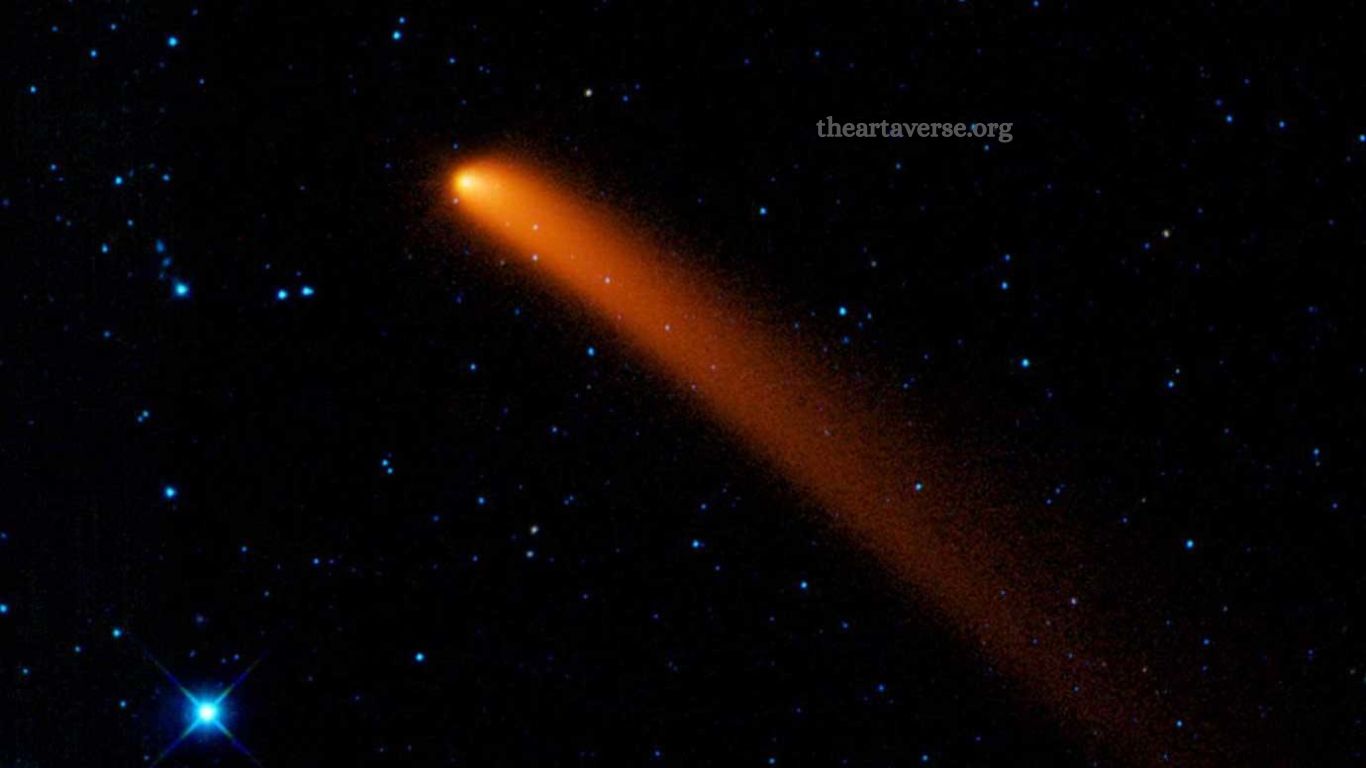
NASA has released detailed observations of interstellar comet 3I/ATLAS, a rare visitor from beyond our Solar System. Discovered on July 1, 2025, by the ATLAS survey in Chile, it’s only the third known interstellar object after ʻOumuamua (2017) and Borisov (2019).
Traveling on a hyperbolic path, 3I/ATLAS is moving swiftly through the inner Solar System and will remain a safe 1.8 AU from Earth. Although some, including astrophysicist Avi Loeb, suggested it might be an alien craft, NASA’s analysis confirms it’s a natural comet composed of CO₂ and water ice, with a nucleus under one kilometer wide.
Discovery and Early Observations
The ATLAS telescope system, designed primarily for early detection of potentially hazardous asteroids, first spotted the faint glow of 3I/ATLAS as it moved against the starry background. Astronomers quickly realized its trajectory was hyperbolic, a clear signature of an object not gravitationally bound to the Sun.
Initial measurements showed that the object was traveling at extremely high speeds faster than any typical comet known to originate from the Oort Cloud. This high velocity confirmed its interstellar origin, making it only the third such visitor ever documented by human instruments.
After its discovery, observatories worldwide turned their instruments toward the object. Both ground-based telescopes and space observatories such as the Hubble Space Telescope and NASA’s James Webb Space Telescope (JWST) began tracking its movement and analyzing its composition through reflected light and emitted gases.
Read More: Chelsea Set to Seal Sensational Transfer for Man United Star Alejandro Garnacho
A Safe but Fascinating Flyby
NASA’s orbital projections show that 3I/ATLAS will not pose any threat to Earth. The comet will pass at a safe distance of about 1.8 astronomical units (AU) roughly 270 million kilometers never coming close enough to pose any impact risk.
While it will remain far from our planet, its approach offers scientists an invaluable opportunity to study a fresh sample of material from another star system without sending a probe beyond the Sun’s influence. Interstellar visitors like this act as natural messengers, carrying chemical and physical clues from distant planetary systems.
Comparing 3I/ATLAS with ʻOumuamua and Borisov
Each interstellar object observed so far has revealed unique and puzzling characteristics. ʻOumuamua, discovered in 2017, had an unusual elongated shape and displayed non-gravitational acceleration, sparking debate about whether it could be artificial. Two years later, Borisov appeared more like a traditional comet, showing a visible coma and tail as it evaporated under sunlight.
In contrast, early studies suggest that 3I/ATLAS combines traits of both predecessors. It shows signs of a coma rich in carbon dioxide (CO₂) and water ice, similar to typical Solar System comets, yet its shape and rotational properties remain under investigation. Its smaller nucleus, likely under one kilometer wide, adds to the intrigue.
NASA’s Analysis and Scientific Findings
Using data from the JWST, Hubble, and several ground observatories, NASA scientists have analyzed the object’s reflected light spectra. The results show strong evidence of volatile compounds, particularly CO₂ and H₂O, confirming it behaves like a natural comet rather than an artificial or rocky object.
Researchers from NASA’s Goddard Space Flight Center report that the light curves graphs showing how the object’s brightness changes over time suggest it is rotating slowly, perhaps once every several hours. The absence of sharp reflections or metallic signatures indicates that 3I/ATLAS is composed primarily of icy and dusty material, typical of natural comets.
The Alien Hypothesis: Science vs. Speculation
Despite NASA’s confidence in its natural origins, some voices in the scientific community and popular media have revived debates sparked by ʻOumuamua. Notably, Harvard astrophysicist Avi Loeb has once again raised the possibility that unusual interstellar visitors could represent technological artifacts perhaps probes sent by distant civilizations.
Loeb points to minor deviations in the comet’s motion that might hint at unknown forces or outgassing patterns. However, most astronomers disagree, emphasizing that all current observations fit well within the expected behavior of a small, icy comet reacting to solar radiation.
NASA’s statement clarifies that no evidence supports the alien spacecraft theory. The agency notes that such speculation, while fascinating, often overshadows the profound natural science behind these discoveries namely, how planetary systems form and evolve across the galaxy.
Why Interstellar Objects Matter
The study of interstellar objects like 3I/ATLAS is far more than a cosmic curiosity. These travelers carry pristine material from their home systems, untouched by the processes that shaped our own Solar System. By studying their composition, scientists can compare how chemical elements and molecules form under different conditions around other stars.
“Every interstellar visitor gives us a unique sample of another planetary nursery,” explained Dr. Karen Meech, an astronomer involved in observing all three known interstellar objects. “It’s like getting a rock from a planet orbiting another sun—without ever leaving home.”
Understanding these visitors could also refine our knowledge of how planetary systems exchange material. Some scientists theorize that comets like 3I/ATLAS may occasionally seed young star systems with organic molecules, potentially contributing to the origins of life.
Technological Advances in Detection
Discovering 3I/ATLAS so quickly after ʻOumuamua and Borisov highlights major advances in astronomical technology. Systems like ATLAS, Pan-STARRS, and upcoming facilities such as the Vera C. Rubin Observatory are revolutionizing how astronomers detect fast-moving or faint objects.
Machine learning algorithms now help sift through millions of nightly images, flagging potential new objects within minutes. This automation allows scientists to react rapidly, coordinating observations from telescopes across the globe before these brief visitors vanish into deep space.
NASA plans to enhance such systems further through its Near-Earth Object Surveyor Mission, expected to launch later this decade. Though primarily focused on planetary defense, this mission will also be capable of identifying more interstellar comets and asteroids, providing early alerts for detailed study.
Public Interest and Global Collaboration
Each time a new interstellar object is discovered, public fascination surges. The combination of scientific wonder and the tantalizing idea of extraterrestrial origins fuels both media coverage and educational outreach.
NASA has leveraged this attention to promote public engagement in citizen science programs, encouraging amateur astronomers to track the comet’s motion. Observatories across Europe, Asia, and South America are collaborating to build a comprehensive dataset of its brightness, color, and trajectory.
Such global cooperation demonstrates how astronomy transcends borders. Every participating observatory contributes a piece of the puzzle, helping scientists construct a full 3D model of the object’s motion and behavior.
Lessons from the Cosmic Wanderer
The journey of 3I/ATLAS underscores how dynamic and interconnected our galaxy truly is. The Milky Way is filled with gravitational interactions between stars that occasionally fling small bodies comets, asteroids, and debris out into interstellar space. Some of these objects may travel for millions or even billions of years before crossing paths with another star system like ours.
Each encounter teaches us not only about distant worlds but also about our own origins. The chemical fingerprints detected in 3I/ATLAS’s composition can be compared with those found in ancient comets within our Solar System, revealing how similar or different planet-forming environments might be across the galaxy.
Looking Ahead: The Future of Interstellar Research
The fleeting passage of 3I/ATLAS will inspire future missions designed to intercept or study interstellar objects directly. NASA’s Interstellar Probe concept, currently under evaluation, aims to send a spacecraft beyond the heliosphere to capture data on the surrounding interstellar medium and perhaps future visitors.
Several independent research teams have also proposed rapid-response missions capable of launching within months of a new discovery. These would carry small probes equipped with cameras and spectrometers to study such objects up close before they leave the Solar System forever.
The next few decades could therefore mark the dawn of interstellar exploration not by traveling to other stars, but by studying the emissaries that come to us.
Frequently Asked Questions
What is 3I/ATLAS?
3I/ATLAS is an interstellar comet discovered on July 1, 2025, by the ATLAS survey in Chile. It’s the third confirmed interstellar object ever detected, following 1I/ʻOumuamua (2017) and 2I/Borisov (2019). Unlike local comets, it originated outside our Solar System and is just passing through.
Why is 3I/ATLAS considered interstellar?
Its hyperbolic trajectory a path that will send it out of the Solar System forever proves it’s not gravitationally bound to the Sun. The object’s extreme speed and direction indicate it came from another star system, making it interstellar in origin.
Is 3I/ATLAS an alien spacecraft?
No. Although some speculation arose, NASA and independent researchers have confirmed that 3I/ATLAS behaves like a natural comet, composed mainly of CO₂, water ice, and dust. There’s no evidence of artificial structure or technology.
Will 3I/ATLAS come close to Earth?
No. The comet will remain a safe distance away about 1.8 astronomical units (AU), or roughly 270 million kilometers from Earth. It poses no threat of collision or impact.
How does 3I/ATLAS compare to ʻOumuamua and Borisov?
ʻOumuamua was an unusual, cigar-shaped object with no visible tail, while Borisov looked like a typical comet. 3I/ATLAS shares features of both it has a visible coma and emits gases, but its small size and fast rotation make it unique among the three.
What can scientists learn from interstellar comets?
Studying interstellar comets helps scientists understand how planets and solar systems form elsewhere in the galaxy. Their composition provides clues about the chemical diversity of other star systems and the possible origins of life-building molecules in space.
Will more interstellar objects be discovered in the future?
Yes. With next-generation observatories like the Vera C. Rubin Observatory and NASA’s NEO Surveyor Mission, astronomers expect to detect many more interstellar visitors in the coming decades. These discoveries will deepen our understanding of the galactic neighborhood and its cosmic travelers.
Conclusion
The discovery of 3I/ATLAS marks another milestone in humanity’s exploration of the cosmos. As NASA and global observatories continue to analyze this interstellar comet, every new data point deepens our understanding of how planetary systems form and evolve across the galaxy. While speculation about alien origins captures the imagination, the true wonder lies in the science studying a natural traveler that journeyed light-years to reach our Solar System.
